
A Box in the Attic: Where Genealogy Meets History
A box of family letters, newspaper clippings, and wartime documents preserved by my mother revealed the story of a World War II merchant seaman, the sinking of SS Delvalle, and the evidence that connected family history to documented historical events.
A Box in the Attic: Where Genealogy Meets History.
It is easy to forget that box in the attic, the one collecting dust and getting pushed further back until it is forgotten. It can happen to any one of us, but by taking the time and going through it, a story can unfold and may answer questions that long ago seemed unanswerable. I have that box, sent to me long after my mother's death, the sheer volume of materials contained within made it a project for another day. What was inside told a story that showed how a family collection cannot only help a genealogist piece a family's story together but it can preserve history, and provide a firsthand account into events from decades past.
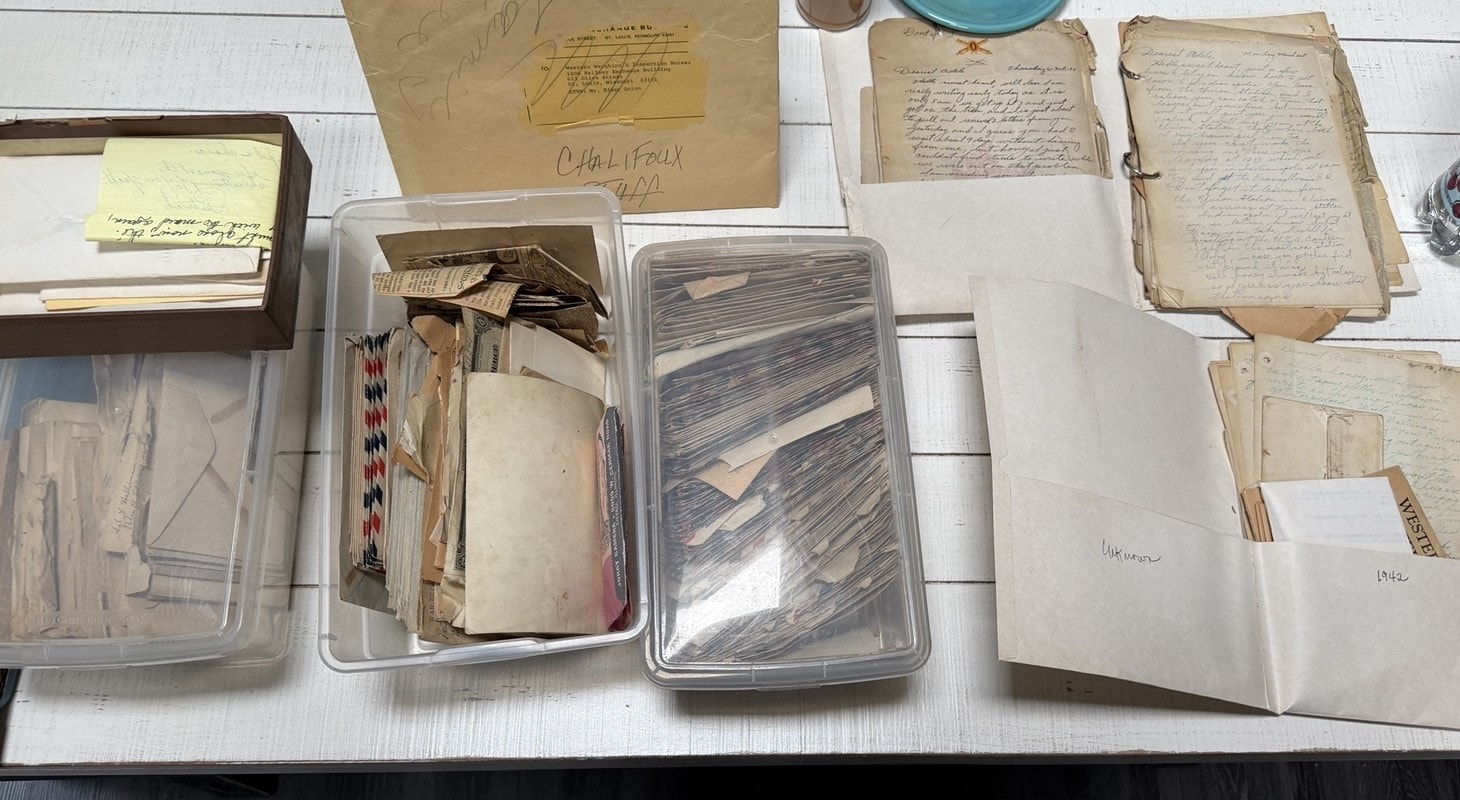
Recently, I decided to tackle the box in the attic, to thoroughly catalog what it contained. My mother had collected the materials from her family's reunion in 1954; this material included a family tree that traced her family back to the early 17th century, memorabilia from a follow-up reunion in 1981, and newspaper clippings, yellowed with age and falling apart were folded and carefully packaged. There were Tupperware bins full of letters and documents, at first glance it appeared to just be love letters but looking closely at the postmarks it quickly became evident that they were organized by date beginning prior to 1941 and continuing through 1945, documenting my father's courtship of my mother, his service in the Merchant Marine, and later his time in the Army.
Figure 1. Family materials preserved by the author's mother, Adele (Boutet) Hallinan.
In one of the boxes containing the older records, a newspaper article from New Orleans States dated 22 April 1942, "N.O. Doctor Lost, Score Saved in Sub Attack." The article that describes the attack my father never directly spoke of, the one that was alluded to in the years following his death. Age had made the clippings brittle and brown, but they were still legible. In the article, Francis Hallinan was quoted "In getting down the side of the ship my right foot got caught in the rope, and in attempting to free myself, I slipped and hanged head downward on the side of the ship." The article goes on to state that Hallinan admitted drinking quite a bit of sea water and oil before one of his fellow crew members aided in his rescue. "I thought I was a goner," he said.
The ship was the SS Delvalle, a merchant vessel sunk south of Haiti on 12 April 1942, by the German U-boat U-154. Survivors were picked up by U.S. Navy patrol aircraft and HMCS Prince Henry (F-70). Turning back to the letters in the 1942 box, a letter dated 3 April 1942 from my father saying he was getting underway soon and letters should be sent to Rio de Janeiro care of Delta Steamship SS Delvalle.
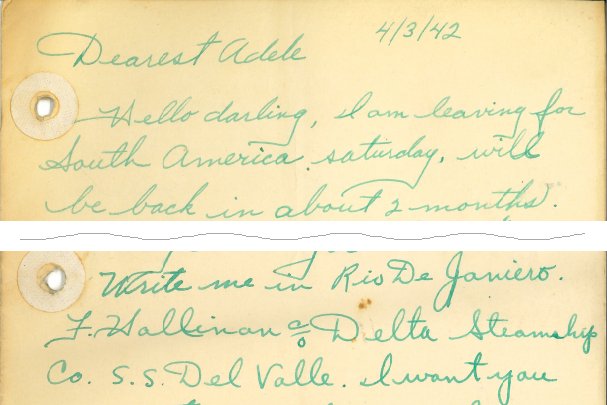
Figure 2. Excerpt from letter from Francis Hallinan to Adele Boutet, 3 April 1942, written aboard SS Delvalle shortly before the vessel's departure.
The next letter in the box was dated 22 April 1942. Unlike the newspaper account, this was not written for reporters or the public. It was written for the woman he hoped to marry.
"Dearest Adele, Apr 22, 1942
Hello honey, well I guess I can't get any of your letters I asked you to write as the ship I was on got torpedoed. Write to me here in New Orleans, F. Hallinan c/o General Delivery New Orleans LA. I plan on going out again as soon as possible, just on a short run and maybe I can go thru with my plans. I won't tell you of the sinking, but here are some of the newspaper clippings
Honey write and let me know how I stand and what you decided in reference to my last letter. I will have to make this letter short as I have about 10 more to write.
Love, Bro"
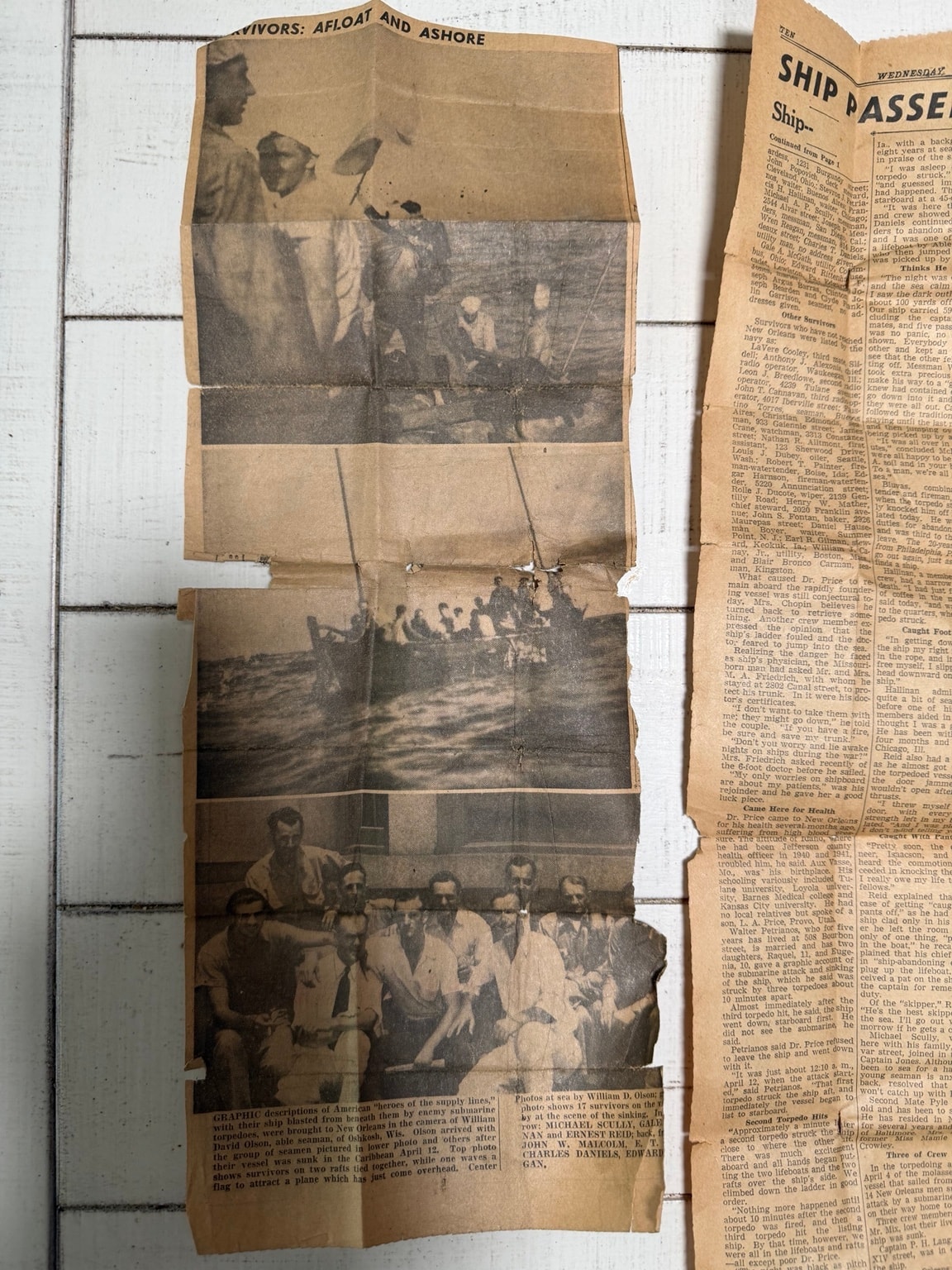
Figure 3. Newspaper photographs of survivors from the sinking of the SS Delvalle, published in the New Orleans States, 22 April 1942.
"Dearest Adele Apr 29 1942
Hello honey, received both your letters yesterday, one has me puzzled though. The letter you wrote to the Union, in it you wrote that Jack and Dick left. Where did they go? New Orleans or where?
Forgive me for not asking you to write before, it must have slipped my mind, and thanks a lot for the picture, I am having some made tonight and will try and have them go with this letter.
I also noticed you didn't forget my birthday, thanks again honey.
I am leaving this week on a short run and will come up there, when I come back, about my tripping over a piece of rope, it wasn't funny or clumsy either, I was going hand over hand down the rope to get into the life raft I thought I had hit the water, but it was only a big wave so I let go , my foot was tangled up as I had twisted the rope around my leg to slow me down, also I got loose by myself, I wasn't scared because I knew I could get loose as soon as another wave came up. I don't know if I was scared when the torpedoes hit, because they were so darn close to me, the explosins (sic) shocked me so much I didn't have time to be scared. I'll tell you this though when we were coming back on the army transport I didn't sleep at all and neither did some of the other fellows. I will admit I was scared then, but mostly thinking of the ship we had just lost. I had better stop now before you go crazy trying to read this letter, say hi to your folks for me and tell G. Mills that he is crazy for getting married (I was only kidding). Call my sister sometime, her phone is Kedzie 557, that is Marion. Inclosed (sic) you will find one of the pictures my buddy took as we had just signaled the rescue ship. Goodby for a little while darling be with you as soon as possible.
Love always Frank"
Sandwiched between the letters was a small three-by-three document that at first appeared insignificant. The form was titled "Merchant Service Permit" with a stamped number 31183 for the Port of Kingston, Jamaica on 13 Apr 1942. It identified Francis Hallinan, Nationality – USA, as a passenger aboard the H.M.S. Prince Henry. Only later, after comparing the permit to newspaper accounts and naval records, did it become clear that the document represented a critical piece of evidence linking the sinking of the Delvalle to the rescue of its survivors.
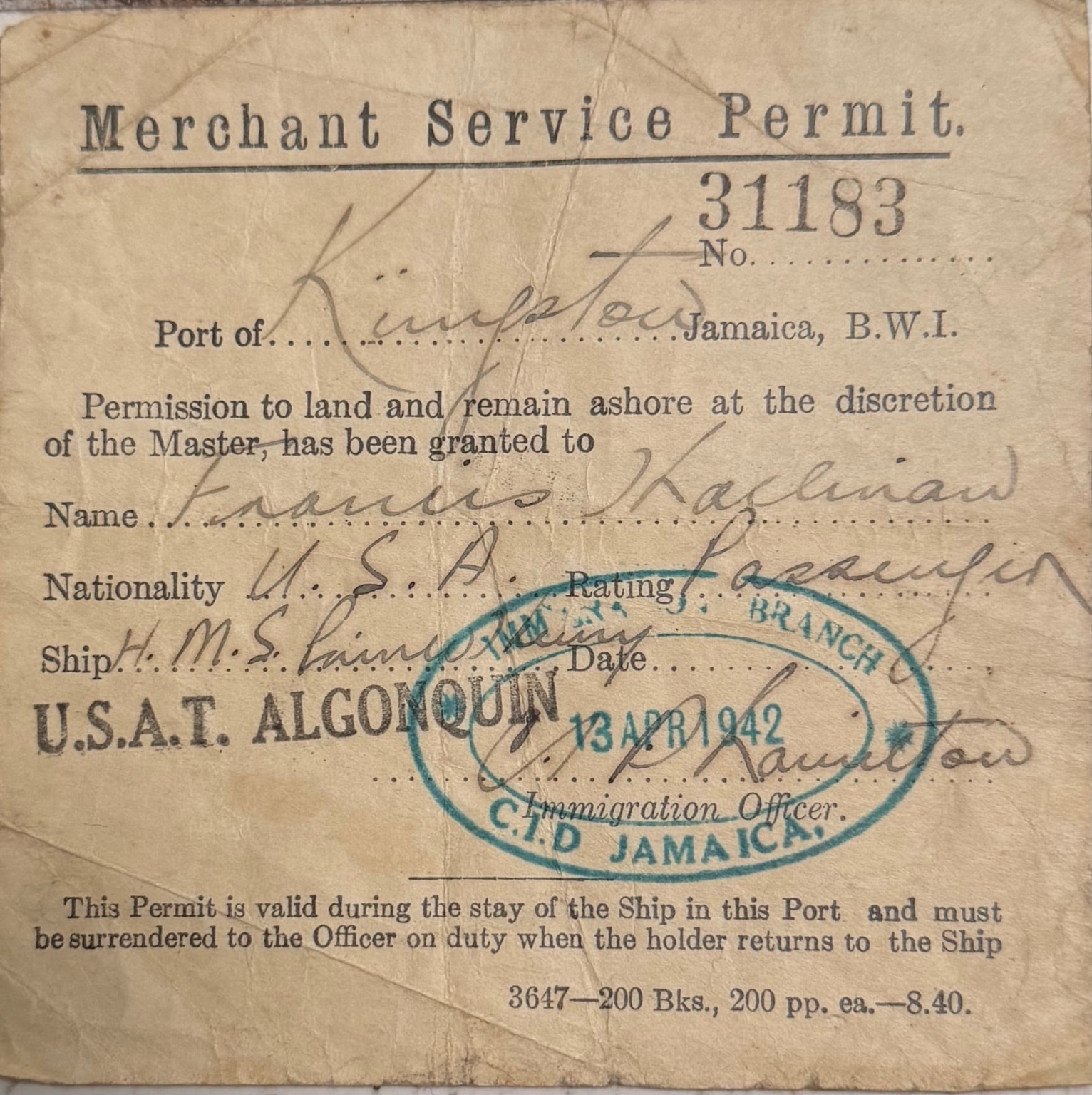
Figure 4. Merchant Service Permit issued at Kingston, Jamaica, 13 April 1942, documenting Francis Hallinan's transfer aboard HMCS Prince Henry following the loss of the SS Delvalle.
What began as a dusty box in the attic became a lesson in the relationship between genealogy and history. A family story became a documented event. A newspaper clipping became evidence. A merchant service permit became a link in a chain of proof. Most importantly, the collection survived because someone chose to save it.
Looking back, I realize my mother was preserving records in much the same way a genealogist would. She saved letters, photographs, newspaper clippings, reunion materials, and family documents without knowing how valuable they would one day become. She never called herself a genealogist, yet because of her efforts a story that began in the Caribbean during World War II could be reconstructed more than eighty years later. In many ways, she was a genealogist long before I ever became one.
Genealogists spend countless hours searching archives, libraries, and online databases for records that illuminate the past. Yet some of the most important discoveries are much closer to home. In this case, a box in the attic contained not only family history, but history itself. The story of the SS Delvalle survived because someone chose to save a newspaper clipping, a handful of letters, and a small permit from Kingston, Jamaica. More than eight decades later, those documents still speak.
Explore Topics
Written by
Brian Hallinan
Family historian and genealogist specializing in documentary research, historical analysis, and the stories preserved within family records.